

For gay men planning a trip to Catalonia, the right base depends on the kind of experience you want. Barcelona puts you in the centre of a major European city, while Sitges offers a more compact coastal setting with a long-established gay scene. Beyond both, the Garraf and Penedès provide a slower alternative for travellers who want space, nature and easy access to the coast without staying in a city.
This guide compares the main options for gay travel Catalonia, helping you choose the base that best matches your travel style.
Catalonia for gay travellers: an overview
Catalonia is one of Spain’s most established destinations for LGBTQ+ travellers. Barcelona provides the energy of a major international city, while the Mediterranean coast offers beaches, smaller towns and a more relaxed rhythm.
For travellers looking beyond the obvious city break, there is also a quieter side to gay-friendly Catalonia. The Garraf hills, the vineyards of the Penedès and the coastal towns around Sitges create opportunities to experience Catalonia at a slower pace.
The region works particularly well for travellers who want to combine different experiences in one trip. You might spend time exploring Barcelona, move towards the coast for a few days in Sitges and then stay somewhere surrounded by nature.
For a broader look at accommodation options for gay travellers, see our guide to gay-friendly accommodation in Spain.
Barcelona: the big-city base (pros and cons)
The advantage is variety. Museums, architecture, restaurants, nightlife, shopping and LGBTQ+ venues are all part of the experience, making Barcelona particularly appealing to travellers who like having plenty of options within easy reach.
For gay travellers, the city also offers a large and diverse LGBTQ+ community. It is an excellent base if nightlife, culture and urban energy are high on your list.
There are, however, trade-offs.
Barcelona is a busy international city, and the experience can feel very different from a relaxed Mediterranean escape. If your idea of a holiday involves slowing down, spending time outdoors and returning to a peaceful base at the end of the day, the city may not be the best fit for the entire trip.
Barcelona works particularly well as part of a longer Catalonia itinerary rather than necessarily being the only place you stay.
Sitges: the coastal gay capital (pros and cons)
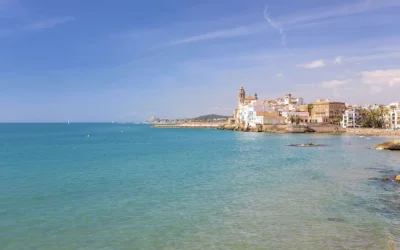
Its appeal is the combination of a compact town, Mediterranean beaches, restaurants, nightlife and an established gay community. For travellers who want to be close to the sea while still having plenty of LGBTQ+ life around them, Sitges is a natural choice.
The town also makes an easy alternative to staying in Barcelona. The train from Barcelona to Sitges takes around 40 minutes, making it possible to combine the two without basing yourself in the city.

But Sitges is not simply a smaller version of Barcelona. Its character is more coastal and holiday-oriented, with a stronger connection to the beach and outdoor life.
Rather than repeating our detailed destination guide here, read our complete gay guide to Sitges for a deeper look at the town, beaches, nightlife and things to do.
Beyond the two: the Garraf, the Penedès and the coast
The landscape around Sitges opens into the Garraf, where hills, vineyards and small residential communities create a much quieter setting. Further inland, the Penedès wine region offers vineyards, wineries, villages and a strong connection to Catalan wine culture.
This part of Catalonia suits travellers who want to combine LGBTQ+ destinations with countryside, food and wine.
A day in the Penedès can add an entirely different dimension to a coastal holiday. See our guide to the Penedès wine region for ideas on exploring the vineyards and wine country.
The wider region also works well for travellers who want to explore beyond the main destinations. Our guide to day trips from Sitges covers some of the possibilities for adding culture, nature and food to your itinerary.

Barcelona vs Sitges: which base is right for you
| Barcelona | Sitges | |
| Atmosphere | Energetic, urban and cosmopolitan | Coastal, relaxed and social |
| Gay scene | Large, diverse and city-based | Established, concentrated and highly visible |
| Beaches | Urban Mediterranean beaches | Mediterranean beaches integrated into the town |
| Pace | Fast and lively | Slower and more holiday-oriented |
| Best for | City culture, nightlife and variety | Beach life, LGBTQ+ atmosphere and a coastal break |
| Type of stay | City hotel or urban apartment | Coastal hotel, guesthouse or private accommodation |
If you want beaches, a strong LGBTQ+ atmosphere and a compact coastal destination, Sitges is the more natural choice.
And if you want something quieter, there is a third option: stay just outside the main destinations and use the coast and Barcelona as places to explore rather than as the place you return to every evening.
Staying near Barcelona and Sitges
Some travellers prefer to walk out of their accommodation and immediately find restaurants, bars and city life. Others would rather have a peaceful base surrounded by nature and travel into the action when they want it.
Many travellers search for a gay resort near Barcelona; in practice, the quieter options in the hills around Sitges are smaller guesthouses, offering gay accommodation near Barcelona without staying in the city.
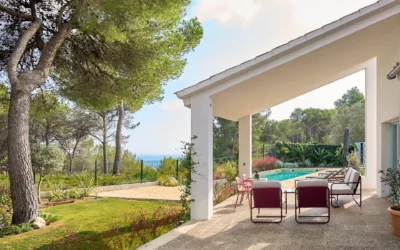
This is where the area around Sitges becomes particularly interesting. In the hills of the Garraf, Casa Brisa, a gay men-only boutique guesthouse near Sitges, offers a quieter alternative to staying in the centre of a busy destination.
Casa Brisa is located in Olivella, in the hills of the Garraf, a short drive from Sitges. It is a small property with four accommodation options and an outdoor pool. Clothing is optional around the pool and sunbathing areas, while the indoor shared spaces are clothed.
For travellers specifically comparing gay-friendly stays in Sitges, this kind of location offers a different proposition: rather than choosing between Barcelona and the centre of Sitges, you can use the surrounding landscape as your base and visit both when you want to.
The choice is therefore less about finding the “best” place and more about choosing the atmosphere you want to wake up in every day.
Frequently Asked Questions
Is Catalonia a good destination for gay travellers?
Should gay travellers stay in Barcelona or Sitges?
Is Sitges close enough to Barcelona for a day trip?
Is there a quieter alternative to staying in Barcelona or central Sitges?
What is the best base for gay travel in Catalonia?
For more ideas on beaches, culture, nature, food and experiences around the region, explore our Things to Do guide.

0 Comments